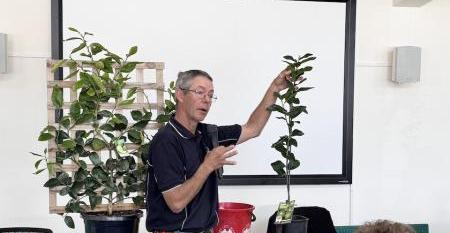
Kate introduced Chris England and his presentation on ‘How to Espalier Plants’. Chris provided lots of tips on how to espalier and also provided a practical demonstration. He distinguished between formal and informal espaliering but only discussed informal espaliering this day.
Chris and his wife Jenny began espaliering plants as a hobby and they now have Merrywood which is a nursery of about 10,000 plants in Baxter where they both live and work. Chris said that over the years, he and his wife had not lost their enthusiasm and passion for what they do. He suggested trying to espalier most plants but not natives. Waratahs are a favourite of Chris’. Chris encouraged us to share photos with him, of what we espalier, and not to hesitate to contact him for advice.
The informal type of espaliering fills a whole area of fence or wall, with the idea being to make as many branches as possible. Trees like to grow vertically so if you remove the shoots at the top and then grow the branches horizontally, the maximum number of fruits and flowers are encouraged. Chris reminded us of when Peter Cundall used to weigh a branch down with a rock.
When identifying a plant for espaliering, Chris advised to look for one with branches down the side. The Tahitian lime was recommended for beginners. The espaliered plants are good for walls and fences to block unwanted views. They can be grown in pots with a vertical structure but pots need more feeding and liquid feeding is particularly good.
Chris demonstrated the technique with a new plant and drastically cut the plant down to just the bottom branches. In November the plants start to grow vertically so time to train the new growth to where you want and clip to structure such as wire or lattice. Keep the plant out of the lattice so you can reattach the plant to a new screen if needed. Do something with new shoots when they are about 20cm long, clipping horizontally for more flowers and fruit. Then take away the dominant shoot again so there is further branching. There may be new growth to train every 6 weeks or so in growing season. Liquid feed plants in the summer time.
Chris recommended integrated pest management (IMP) where good bugs eat the bad bugs and there are businesses such as Bugs for Bugs that can post out bugs to predate on the bad bugs in your garden. Good bugs may need a top up in summer time. He advised there is no real solution for fruit fly and recommended against the yellow sticks that trap all bugs. Gall wasp comes out in October in Melbourne and lay eggs on new growth so spray safe oils (eg: Neem or white oil) which discourages egg laying and similarly spray for leaf minor in January/February.
Kate thanked Chris for such a ‘delightfully informative’ presentation.